

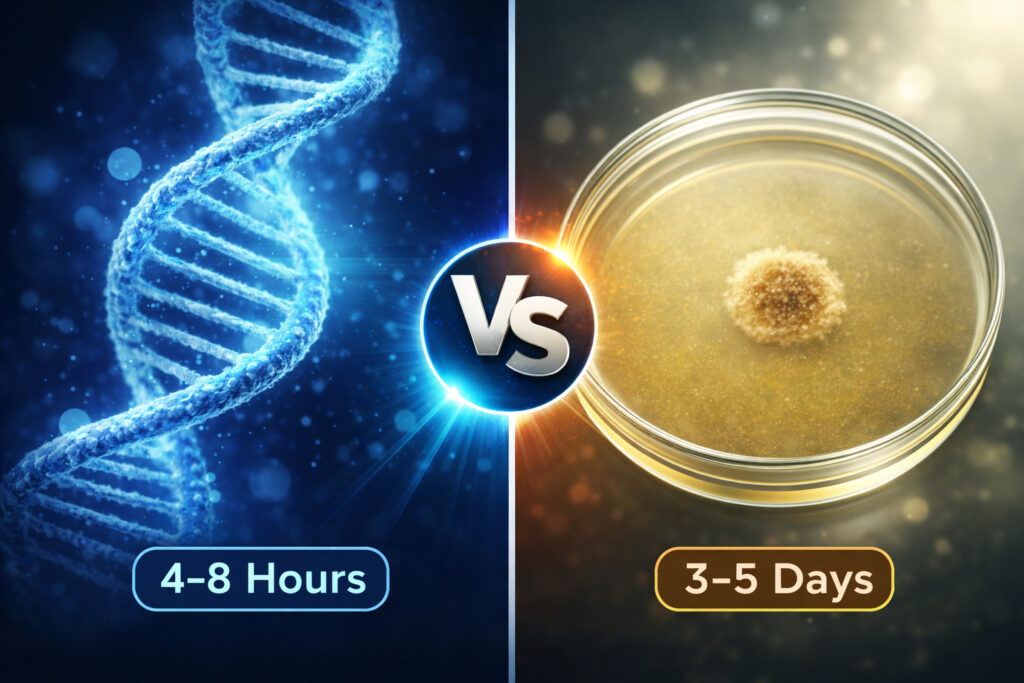
Molecular PCR diagnostics have transformed infectious disease detection by enabling rapid pathogen identification with high sensitivity and specificity, within 4–8 hours. Unlike traditional culture-based methods that require 24–72 hours or longer, PCR allows clinicians to diagnose and treat infections with precision during the earliest stages of disease.
In today’s healthcare environment—where outcomes, efficiency, and cost control are tightly linked—PCR molecular diagnostics represent a critical advancement in both clinical care and operational performance.
Molecular PCR–based pathogen detection has been a validated diagnostic technology for decades and has been widely used in infectious disease diagnostics long before the COVID-19 pandemic brought the technology into public awareness. PCR testing has consistently demonstrated the ability to rapidly and accurately identify bacterial, viral, and fungal pathogens responsible for infectious disease.

Modern open PCR platforms allow hospitals to test a broad range of infectious organisms directly from patient samples with approximately 99% sensitivity and specificity, while simultaneously detecting clinically relevant antimicrobial resistance markers. This capability enables highly accurate pathogen identification within 4–8 hours, compared with traditional culture-based workflows that typically require 24–72 hours or longer.
This rapid diagnostic capability allows physicians to initiate targeted antimicrobial therapy within the first 24 hours of clinical presentation, rather than relying on empiric broad-spectrum treatment while awaiting culture results.
Clinical Impact of Rapid PCR Testing
PCR-based testing allows for the direct detection of bacterial, viral, and fungal DNA or RNA from patient samples, eliminating the need for organism growth. Earlier and more precise pathogen identification produces measurable clinical benefits, including:
Operational Benefits of In-House PCR Laboratories:
- • Faster resolution of infection
- • Reduced disease progression and complications
- • Targeted antimicrobial therapy within 24 hours
- • Improved antimicrobial stewardship
- • Reduced reliance on broad-spectrum antibiotics
- • Lower incidence of antibiotic-resistant organisms
Modern PCR platforms enable multiplex testing, allowing multiple pathogens to be identified from a single sample. This capability is central to rapid PCR testing programs implemented through an in-house lab, physician-owned lab (POL), or broader hospital laboratory expansion, as part of a comprehensive PCR lab setup.
Rapid molecular diagnostics are particularly valuable in conditions where time to appropriate therapy significantly influences outcomes, including respiratory infections, urinary tract infections, wound infections, gastrointestinal infections, nail infections, vaginitis, sexually transmitted infections (STDs), and systemic infections.
PCR vs Traditional Culture: Why Speed Matters
Traditional culture-based diagnostics have long been considered the standard—but they are inherently limited. Rapid PCR testing improves clinical outcomes by enabling earlier pathogen identification and targeted therapy
Culture Limitations:
- Requires organism growth (often incomplete)
- 24–72+ hour turnaround time
- Misses pathogens in up to 40% of cases
- Limited detection of resistance markers
PCR Advantages:
- 4–8 hour results
- ~99% sensitivity and specificity
- Detects multiple pathogens simultaneously
- Identifies antimicrobial resistance genes
Bottom line:
Culture delays treatment. PCR enables precision care.
Operational Benefits for Hospitals
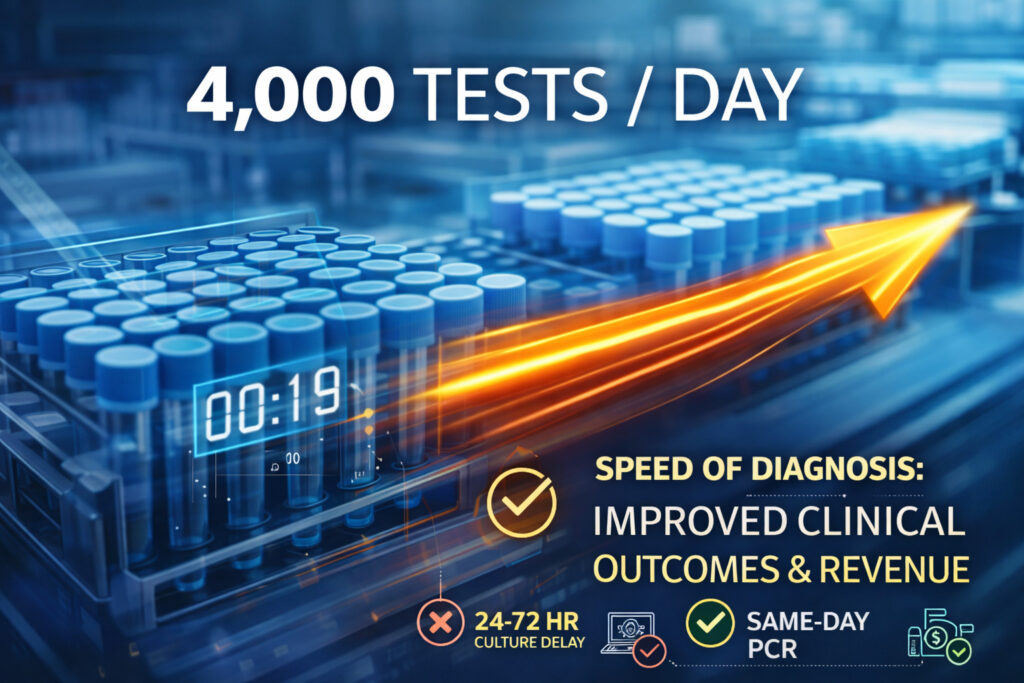
Speed is not just clinical—it is operational.
Implementing rapid PCR testing through an in-house lab or physician-owned lab (POL) model enhances workflow across the entire care continuum. Whether part of a PCR lab setup or broader hospital laboratory expansion, this approach improves clinical workflow and patient management, including:
- • Accelerated clinical decision making
- • Reduced diagnostic uncertainty
- • Improved infection management protocols
- • More efficient discharge planning
- • Reduced inpatient length of stay
Published analyses demonstrate that rapid molecular diagnostics can reduce hospital length of stay by approximately 1–2 days for infectious disease admissions, while also reducing unnecessary antimicrobial utilization.
Financial Impact & ROI of PCR Diagnostics
The cost-benefit profile of molecular PCR diagnostics strongly favors institutions that implement rapid pathogen detection programs.
Financial benefits occur through both diagnostic reimbursement and downstream cost savings, including:
PCR diagnostics are not just clinically superior—they are financially strategic.
Revenue + Cost Savings Drivers:
- • Reimbursement for molecular diagnostic testing
- • Reduced pharmacy costs associated with empiric broad-spectrum therapy
- • Reduced hospital length of stay
- • Reduced ICU utilization
- • Reduced costs associated with hospital-acquired infections
Estimated Impact:
Published healthcare economic analyses demonstrate substantial cost savings per infection episode when rapid molecular diagnostics enable earlier, targeted therapy.
- $1,500–$4,000 savings per infection episode
- Millions in annual savings across health systems
This is one of the rare technologies that improves:
✔ outcomes
✔ efficiency
✔ revenue
Across large health systems, these improvements can translate into millions of dollars in annual institutional savings while simultaneously improving patient outcomes. Physician groups are increasingly investing in physician-owned PCR labs to capture both clinical and financial value.

Why PCR is a Strategic Diagnostic Advancement
PCR molecular diagnostics represent a significant advancement in infectious disease management by providing rapid early pathogen identification and antimicrobial resistance detection.
This allows clinicians to move quickly from empiric therapy to precision-guided treatment, improving both patient outcomes and healthcare resource utilization. Particularly in urinary tract infections where PCR has demonstrated superior accuracy compared to culture-based methods.
Traditional culture:
- 24–72+ hours
- incomplete detection
- delayed treatment decisions
PCR:
- same-day results
- multiplex detection
- resistance marker identification
But the real advantage is not just speed—it is:
The ability to redesign clinical and operational workflows around faster, more accurate data
Implementation Models: Hospital-Based vs Physician-Owned Lab (POL)
One of the biggest misconceptions is that PCR labs are only for large institutions. The opposite is true. Hospitals have historically lagged in adopting rapid PCR testing at scale, where as private practice urologists have implemented physician-owned PCR labs (POLs) for decades, and primary care physicians are increasingly adopting these models to improve clinical outcomes and capture additional revenue.
Available Models for Turnkey Lab Setup – Built & Running in 6-8 weeks
- 1. Fully Entity or Physician-Owned PCR Lab Model
Maximum revenue capture
Full control of operations - 2. Hosted / Remote Lab Model
No heavy capital investment
Centralized processing with revenue share
POL & Molecular Lab Design Considerations:
PCR implementation is not one-size-fits-all. It is tailored to each practice or institution based on key variables, including patient volume, clinical needs, and whether the optimal model is an in-house lab, physician-owned lab (POL), or part of a broader hospital laboratory expansion through a comprehensive PCR lab setup.
- Daily patient throughput
- Infection prevalence (UTI, respiratory, wound, etc.)
- Referral potential
- Patient volume
- Testing Demand
- Insurance
- Demographics
Right-sized volume = scalable revenue + efficiency
Clinical Use Case and Specialty Alignment
Different practices require distinct testing strategies, with molecular diagnostics implementation aligned to clinical demand, patient volume, and broader operational and financial objectives.
- Primary care → UTI, respiratory panels, vaginitis, STD, nail
- OBGYN → Vaginitis, STD
- Wound care → wound, blood
- Urgent care → high-throughput respiratory + mixed infections
- Hospitals → sepsis, inpatient diagnostics: Urine, Respiratory, Blood, GI
The panel selection and workflow must match the clinical reality—not a generic lab model.
Operational Infrastructure
POL for PCR testing require:
- Workflow integration
- Specimen handling protocols
- Reporting systems
- Specifically trained personnel
Key Questions:
- Is the infrastructure available or easily acquired?
- Would outsourcing relieve the daily stress of running a practice?
- How much work is desired to implement the new income stream?
- Which are the key labs that the practice utilizes?
Financial Model and Risk Tolerance
There are multiple ways to structure a PCR lab setup, and the optimal model depends on clinical demand, patient volume, and financial objectives. Both physician-owned lab (POL) and in-house laboratory models can be implemented efficiently—often within 6–8 weeks—when aligned with the appropriate operational strategy.
Fully Physician-Owned PCR Lab: POL Model
A physician-owned lab (POL) offers the highest level of control and revenue potential, but requires active oversight and operational engagement.
- Highest revenue potential
- Full operational control
- Greater management responsibility
- Scalable for future growth
- Primarily for PCR & PGX testing
In-House PCR Laboratory (Hospital-Based Model)
An in-house lab, often part of hospital laboratory expansion, enhances clinical workflow and turnaround time while requiring internal oversight and integration into existing systems.
- Improved turnaround time and clinical efficiency
- Enhanced care coordination
- nstitutional control of diagnostics
Hosted / Remote Model
A hosted or remote model provides access to rapid PCR testing without the need for full ownership or infrastructure investment.
- Lower upfront investment
- Minimal operational responsibility
- Broader test menu (PCR, toxicology, blood panels, PGX)
- Lower revenue per test
- Ideal for practices prioritizing simplicity
Choosing the Right Model
There is no universally “best” option. The appropriate approach depends on a combination of clinical demand, patient volume, operational capacity, and financial objectives.
- Operational involvement and oversight preferences
- Capital investment and ROI expectations
- Patient volume and testing demand
- Clinical growth and service expansion goals
- Desired balance between control and scalability
Reimbursement and Compliance Strategy
PCR testing intersects with:
- payer variability
- coding accuracy
- documentation requirements
Improper setup can lead to:
❌ denied claims
❌ compliance risk
❌ lost revenue
This is where strategic financial planning and effective billing matters most.
Strategic Implementation & Next Steps
Molecular PCR diagnostics have fundamentally changed infectious disease management— rapid PCR testing delivers highly accurate pathogen identification with local antibiotic resistance profiles within 4–8 hours.
Molecular PCR diagnostics implementation is not simply a clinical upgrade. It is a strategic operational and financial decision that must be aligned with the realities of the practice demographics, patient population, and infrastructure.
The question is no longer whether PCR works.
The question is which model is right—and how to implement it effectively without introducing operational inefficiencies, compliance risk, or lost revenue.
Healthcare systems and physician groups that implement molecular PCR diagnostics through POLs are positioning themselves at the forefront of precision infectious disease management—improving outcomes while unlocking significant new revenue streams.
The question is no longer if PCR should be implemented—
it’s how quickly you can deploy it correctly and profitably.
There are multiple implementation models including fully owned and hosted turnkey lab solutions to meet the clinical demand.
Why Most Implementations Fail to Reach Full Potential
Common mistakes:
- Choosing the wrong lab model
- Overestimating volume
- Underestimating operational complexity
- Failing to align clinical workflows
- Ignoring reimbursement strategy
PCR doesn’t fail—implementation does.
A Strategic Approach to PCR Implementation
Implementation of PCR molecular diagnostics varies based on institutional goals, patient volume, and financial structure. Hospitals may integrate in-house PCR laboratories to improve turnaround time and reduce length of stay, while physician groups may pursue physician-owned lab (POL) models to generate new revenue streams while maintaining clinical control.
Successful implementation requires:
✔ Volume analysis
✔ Clinical workflow alignment
✔ Financial modeling
✔ Compliance strategy
✔ Operational planning
This is not a vendor decision—it is a clinical, operational, and financial strategy decision.
From Strategy to Execution
The most important first step is a structured assessment of clinical demand, patient volume, and operational capacity. From there, a tailored implementation plan can be developed for:
- Hospital systems
- Multi-site groups
- Solo providers
This tragic evaluation defines:
- Feasibility
- Lab model options
- Implementation timing
Speed to Implementation
With the right structure and alignment, a fully functional PCR lab setup can be operational within 6–8 weeks—generating revenue while improving clinical outcomes.
Whether fully owned, shared revenue, or turnkey hosted, the model can be designed to align with the clinical, operational, and financial goals of the institution, group, or individual physician.
Explore Implementation Models
Frequently Asked Questions About PCR Molecular Diagnostics & Physician-Owned Labs (POLs)
What is a physician-owned PCR lab (POL)?
A physician-owned PCR lab (POL) is an in-house laboratory that enables providers to perform rapid molecular diagnostics within their practice, improving turnaround time, clinical control, and revenue generation.
This model allows physicians to capture lab revenue while delivering faster, more accurate diagnostic results.
How do you start a physician-owned PCR lab?
Starting a physician-owned PCR lab involves selecting a lab model, completing CLIA and regulatory requirements, establishing workflow integration, and implementing PCR testing platforms.
Most turnkey PCR lab setups can be operational within 6–8 weeks with proper planning and compliance support.
What is the cost of setting up a PCR lab?
PCR lab setup costs vary depending on whether the model is fully physician-owned or hosted, as well as testing volume and equipment needs.
Many models offer low or no upfront cost options with revenue-sharing structures, making implementation accessible for a range of practices.
How long does it take to set up a PCR lab?
A PCR lab can typically be set up and fully operational within 6–8 weeks, depending on the implementation model, compliance requirements, and workflow integration.
Both physician-owned labs (POLs) and hosted lab models can be deployed efficiently with the right strategic planning.
Is PCR more accurate than traditional culture testing?
YYes, PCR molecular diagnostics are significantly more sensitive than traditional culture testing and can detect pathogens that may not grow in culture.
PCR also delivers faster results, enabling earlier targeted therapy and improved patient outcomes.
What is the turnaround time for PCR testing?
PCR testing typically delivers results within 4–8 hours, compared to 3–5 days for traditional culture methods.
This rapid turnaround improves clinical decision-making and reduces delays in appropriate treatment.
What is multiplex PCR and why is it important?
Multiplex PCR allows multiple pathogens to be detected from a single sample, including bacterial, viral, and fungal organisms.
This is especially important in polymicrobial infections where traditional testing may miss co-infections.
What types of infections can PCR testing detect?
PCR testing can detect bacterial, viral, and fungal infections from a single sample, including respiratory infections, urinary tract infections, wound infections, gastrointestinal infections, and sexually transmitted infections.
Multiplex PCR panels allow simultaneous identification of multiple pathogens, improving diagnostic accuracy in polymicrobial infections.
What is the difference between a POL and a reference lab?
A physician-owned lab (POL) provides in-house testing with faster turnaround and higher revenue potential, while reference labs require sending samples out with longer result times and less financial benefit to the provider.
POLs offer greater clinical control and improved workflow efficiency.
Can small practices implement PCR testing?
Yes, PCR lab implementation can be tailored for solo providers, specialty practices, and multi-site groups based on patient volume and clinical demand.
Flexible models allow smaller practices to adopt rapid PCR testing without significant operational burden.
How do I choose between an in-house PCR lab and a hosted model?
The choice between an in-house PCR lab (POL) and a hosted model depends on patient volume, operational capacity, and financial goals.
A structured assessment ensures alignment between clinical demand, workflow efficiency, and revenue objectives.
How does PCR improve hospital workflow and outcomes?
PCR molecular diagnostics improve hospital workflow by reducing time to diagnosis, shortening length of stay, and enabling earlier targeted treatment.
This leads to improved patient outcomes and more efficient use of hospital resources.
How do I determine the right PCR lab model for my practice or hospital?
The right PCR lab model depends on patient volume, clinical demand, operational capacity, and financial objectives.
A structured assessment ensures the selected approach aligns with both clinical outcomes and long-term revenue strategy.
Ready to Evaluate PCR Implementation for Your Practice or Hospital?
A structured consultation can determine the optimal PCR lab model based on volume, workflow, and financial goals.

Rewelacyjnie napisane! Od razu chce się zastosować